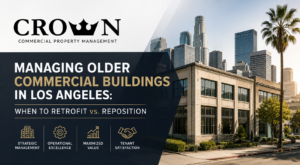
Older commercial buildings in Los Angeles come with character, history, and usually at least one mystery plumbing issue hidden behind a wall somewhere. But they also come with opportunity. The challenge is figuring out whether your property needs a true retrofit investment or simply a smarter repositioning strategy to stay competitive in today’s market.
If you own an aging office, retail, or mixed-use building in LA, making the wrong call can cost you far more than deferred maintenance ever did.
Key Takeaways
- Older commercial properties in Los Angeles can still outperform newer assets with the right strategy.
- Retrofitting focuses on physical upgrades like systems, compliance, and infrastructure.
- Repositioning focuses on changing how the property competes in the market.
- Rising insurance costs, seismic requirements, and tenant expectations are forcing owners to make decisions faster.
- Sometimes the smartest investment is not a full renovation, but a targeted upgrade plan with better management and leasing strategy.
The Big Question: Is the Building Functionally Obsolete?
Not every older building is “outdated.” Some are simply under-managed or marketed poorly. Others genuinely struggle because their systems, layouts, or code compliance no longer fit tenant expectations.
The first thing you should evaluate is whether the building’s problems are operational, physical, or market-driven.
If tenants complain about poor HVAC performance, electrical limitations, elevator reliability, or outdated fire/life safety systems, you may be looking at a retrofit scenario.
If the building itself functions adequately but vacancies remain high because the property feels tired, poorly branded, or lacks amenities tenants now expect, repositioning may deliver a stronger return with lower capital costs.
And yes, adding decent Wi-Fi infrastructure in 2026 now somehow qualifies as a “building amenity.” Welcome to commercial real estate.
When Retrofitting Makes Financial Sense
Retrofitting becomes necessary when aging infrastructure starts affecting safety, compliance, leasing, or long-term value.
In Los Angeles, seismic retrofitting alone has become a major consideration for many owners. Add rising utility costs, stricter environmental standards, and increasing tenant expectations, and many older buildings simply cannot compete without upgrades.
Common retrofit projects include:
- HVAC modernization
- Electrical capacity upgrades
- ADA compliance improvements
- Seismic strengthening
- Energy efficiency improvements
- Roof and plumbing system replacements
Here’s a simplified comparison of how older building upgrades often impact operations:
| Upgrade Type | Typical Benefit | Potential Impact |
|---|---|---|
| HVAC Modernization | Improved tenant comfort | Higher retention |
| LED/Energy Upgrades | Lower operating costs | Reduced utility expenses |
| Seismic Retrofit | Risk reduction/compliance | Improved insurability |
| Lobby/Common Area Renovation | Better first impressions | Increased leasing activity |
| Access Control & Security | Tenant confidence | Competitive positioning |
The key is prioritization. You do not always need a complete gut renovation. Strategic upgrades targeted at operational pain points often produce the best ROI.
When Repositioning Is the Better Move
Sometimes the building is not the problem. The positioning is.
Many older commercial properties in Los Angeles were designed for a completely different tenant market than today’s environment. Office buildings built for traditional law firms may now compete better as creative suites or flexible workspace environments. Older retail centers may perform better with service-based tenants rather than traditional retail.
Repositioning can include:
- Rebranding the property
- Updating signage and curb appeal
- Improving tenant mix
- Adjusting lease structures
- Adding flexible workspace layouts
- Enhancing outdoor/common areas
- Modernizing marketing and online presence
This approach often costs significantly less than major construction while still improving occupancy and rental performance.
The reality is tenants compare your building to everything else they see online within seconds. If your listing photos still look like they were taken during the flip-phone era, repositioning may be overdue.
The LA Factor: Insurance, Regulations, and Tenant Expectations
Los Angeles owners face pressures that go beyond normal aging buildings. Insurance carriers are scrutinizing older properties more aggressively. Operating expenses continue climbing. Tenants increasingly expect updated amenities even in mid-tier buildings.
At the same time, construction costs remain high, making careful capital planning critical.
That is why successful owners typically avoid emotional decisions. Instead of asking, “Do I love this building?” the better question is, “What investment actually improves long-term performance?”
Sometimes that means a major retrofit. Sometimes it means smarter leasing strategy, cosmetic upgrades, and tighter operations.
Often, it is a combination of both.
If you own an older commercial property in Los Angeles and are evaluating how to improve performance, tenant retention, or long-term value, Crown Commercial Property Management can help you assess the property from both an operational and investment perspective.
Request a free quote from CCPM and learn how strategic management, repositioning, and capital planning can help your commercial property remain competitive in a changing Los Angeles market.